

Best Handrail Kits for Self Build Projects
- chrisarmo1
- Jul 11
- 6 min read
A handrail is one of those details that can make a self-build staircase, deck or entrance look finished - or look like an afterthought. The best handrail kits for self build projects combine the right material, reliable fixings and a layout that is easy to measure before you order. Get those three points right and you can achieve a clean, professional result without paying for a fully bespoke installation.
For most UK projects, stainless steel remains the sensible choice. It suits modern glass balustrades, works with timber or steel staircases and gives external areas a crisp architectural finish. However, not every kit is suitable for every location. A wall-mounted stair rail has different demands from a freestanding garden handrail, and a coastal balcony needs a higher grade of corrosion resistance than an internal landing.
What makes the best handrail kits for self build?
The right kit is not simply the cheapest rail supplied in a box. A proper system should include compatible components, clear dimensions and fittings designed for the surface you are fixing into. It should also give you the flexibility to cut the rail to length or add turns, end caps and brackets where your layout requires them.
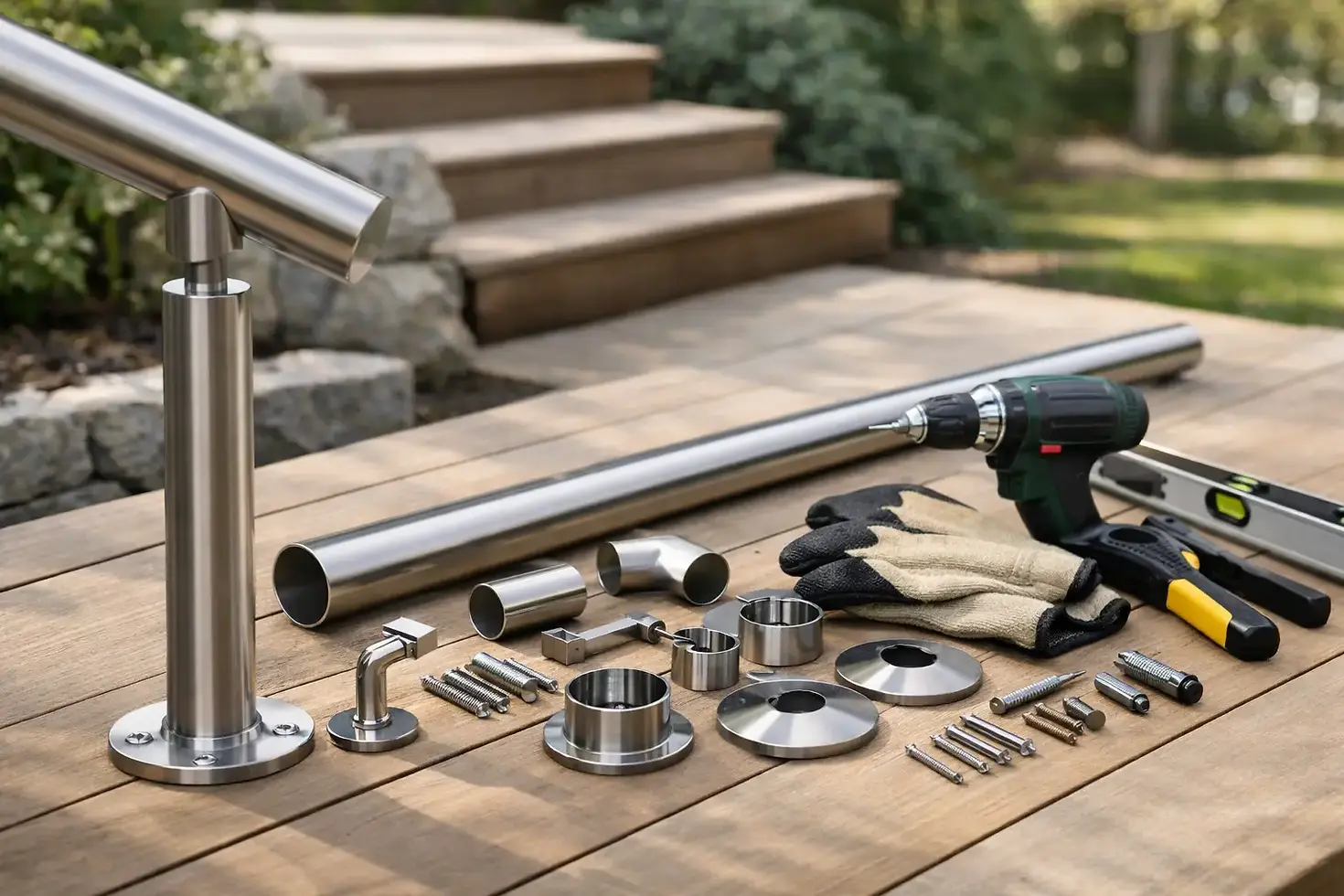
For a self-build customer, the key benefit of a kit is certainty. You should know whether you are buying a round tube handrail, a slotted rail for glass, wall brackets, post brackets, elbows, joiners and end caps - rather than discovering halfway through installation that essential parts are missing. This matters particularly on staircases, where the rail angle, wall construction and clearances all need to be considered before drilling begins.
Material grade is equally important. Satin polished 316 grade stainless steel is the preferred option for external handrails, balconies and exposed installations. It provides significantly better resistance to corrosion than lower-grade alternatives and keeps its appearance well in typical British weather. For internal work, other materials may be appropriate, but 316 stainless steel provides a consistent finish if you are matching an outside terrace, balcony or entrance rail.
Choose the kit to suit the installation
Wall-mounted handrail kits
Wall-mounted kits are a practical option for staircases, corridors, ramps and access routes where a separate balustrade is not required. They generally consist of a handrail tube, wall brackets, end caps and joins or bends where needed. They are ideal where the wall is structurally suitable and the aim is to create a secure, continuous grip line without taking up floor space.
The quality of the brackets matters more than many buyers expect. A rail can look excellent but still feel poor if brackets are widely spaced, badly aligned or fixed into unsuitable plasterboard. Establish what sits behind the finished wall surface. Masonry, structural timber and steelwork need different fixings. If the wall is timber stud construction, locate the studs or install suitable pattressing before the wall is closed up.
Wall-mounted rails are often the most cost-effective route for a straightforward internal stair. They are not, however, a substitute for guarding where there is a fall risk. If the open side of a staircase, landing or raised deck needs protection, you may require a balustrade as well as a handrail.
Post-mounted stainless steel handrail kits
Post-mounted kits are suited to external steps, garden paths, ramps, terraces and locations where there is no wall to fix to. The handrail is supported by upright posts, usually secured with base plates to concrete, steel or a properly reinforced deck structure. This creates a freestanding system that can follow a level run, a slope or a series of changes in direction.
This type of kit gives greater flexibility, but accurate setting out is essential. Check the post centres, rail height and footing or base plate positions before ordering. Small measuring errors become far more noticeable once several posts are installed in a line. On a sloping path or staircase, consider whether the posts and top rail are designed to accommodate the angle, rather than relying on improvised cuts on site.
For external installations, choose 316 grade satin polished stainless steel and use compatible stainless steel fixings. Mixing lower-quality fixings with a premium handrail system can create staining and maintenance problems that are avoidable from the start.
Glass balustrade handrail kits
A glass balustrade handrail kit is the strongest choice when you want safety and a clear, contemporary appearance. It can be used with framed glass systems, stainless steel posts or selected frameless arrangements, depending on the specification. The top rail adds a tactile handhold and can also provide additional support across a run of glass panels.
The main decision is whether the handrail is required for appearance, user comfort, system performance or all three. A slotted stainless steel handrail is made to sit over the top edge of glass, while a post-mounted rail is supported independently from the glass. The right choice depends on the glass thickness, fixing method, balustrade design and the loading requirements of the project.
Do not assume that any glass panel can take any rail. Toughened or laminated safety glass, panel dimensions, edge finishes and support details must all be specified as part of the system. Where the project involves an elevated deck, balcony, landing or commercial setting, obtain technical advice before purchase rather than trying to adapt general-purpose components.
Measure before you buy components
Most avoidable kit problems start with incomplete measurements. Measure the full run rather than relying on the opening size, including returns at the top and bottom of a staircase. Record the rail height required, the angle of any slope, the number of corners, and whether the rail terminates at a wall, post or open end.
For a wall rail, measure from finished floor level and account for carpet, tile, timber flooring or stair nosings. For a post-mounted system, confirm the finished surface build-up before choosing post lengths. A deck that has not yet received its boards or paving can change the final rail height considerably.
It is also worth planning the visual details early. Satin stainless steel works well with brushed door furniture, aluminium frames and modern glass, but the diameter of the rail, style of end cap and bracket shape all affect the final look. A simple round rail with neat wall brackets is usually the safest choice for a contemporary home. More decorative layouts can work, but they often require more components and more precise installation.
Safety and compliance should shape the design
A self-build handrail needs to feel safe in everyday use, but it may also form part of a regulated guarding system. Requirements can vary according to whether the installation is internal or external, residential or commercial, and whether it protects a staircase, ramp, balcony, deck or change in level.
Building Regulations guidance, including Approved Document K in England, should be considered at the design stage. Scotland, Wales and Northern Ireland have their own requirements and guidance, so do not rely on a measurement copied from another project or an online photograph. Height, gaps, climbability, loading and fixing strength can all affect the specification.
This is where buying from a specialist supplier has value. UK Glass Products can supply DIY handrail kits and components alongside technical support for stainless steel and glass balustrade projects. If your layout is unusual, or the handrail is part of a balcony or stair guarding system, send over measurements and photographs for a quotation before ordering individual parts.
Common self-build mistakes to avoid
The most common error is choosing a rail based only on appearance. A slim, polished handrail may look right on a product page, but it may not suit an exposed garden, a busy access ramp or a glass system with a different tube profile. Select the system first, then choose the finish.
Another frequent issue is underestimating the substrate. Concrete, brick, blockwork, timber joists and steel frames all need appropriate fixings and fixing positions. Base plates should not be bolted through weak decking boards alone, and wall brackets should not be fixed only into a plasterboard face. The rail is only as secure as the structure beneath it.
Finally, avoid ordering exact rail lengths without allowing for cuts, joins and returns. A careful cutting plan reduces waste, but it also gives you a little tolerance for site conditions that are rarely as square as a drawing suggests.
A well-chosen handrail kit should make your self-build easier, not force compromises at the final stage. Start with the location, measure the finished structure and choose 316 grade stainless steel where weather exposure demands it. If there is any doubt over glass, guarding or fixing details, ask for technical advice before you place the order - it is the simplest way to keep the finished handrail safe, clean-lined and built to last.


Comments